
Last Updated: November 1, 2026
Quick Summary
The best alternatives for curated decor are curated boutique ranges, specialist linen and textile retailers, and second-hand or vintage sellers, which offer a tighter edit than volume-driven homewares stores. Expect to pay $57-$100 per cushion or throw at curated boutiques, and buy fewer, better pieces that layer together.
- Curated boutique ranges cost $57-$100 per cushion or throw and suit layered, collected rooms.
- Specialist linen and textile retailers charge $80-$180 per throw for bedroom and soft-furnishing depth.
- Before switching retailers, confirm delivery cost, return window and who pays return postage.
- A living room refresh typically needs one throw and two cushions to stay intentional.
- The most common budget mistake is buying five cheap accent pieces instead of two good ones.
Table of Contents
- Why Shoppers Look Beyond Volume Retailers for Curated Decor
- How We Chose These Home Decor Stores
- Side-by-Side Comparison: Price and Value
- Affordable Home Decor Picks That Still Feel Elevated
- Cushions and Soft Furnishings for Texture and Layering
- How to Style a Curated Home Without Hiring a Designer
- Building Your Curated Look with AVE-BA HOUSE
- Frequently Asked Questions
Why Shoppers Look Beyond Volume Retailers for Curated Decor
Large homewares chains are known for their range. But a growing number of shoppers want the best alternatives for curated decor: pieces chosen with a point of view, not pulled from a catalogue that thousands of other homes already own.
The core issue is volume. Large home decor stores often buy and sell in volume, which can keep prices lower but may narrow the range. For a deeper explanation of why curated decor looks better, read our full article.
What Sets a Curated Look Apart
A curated look is a room where every piece earns its place through texture, tone and proportion, rather than matching a single catalogue theme. It reads as personal because it mixes materials, weights and eras instead of repeating one finish.
Three things separate it from a standard retail look:
- Texture layering. Chunky knits, quilted texture and raw linen sit beside smoother surfaces, so the eye has somewhere to rest.
- A restrained colour palette. Two or three tones repeated across cushions, throws and decorative vessels hold a room together.
- Deliberate imperfection. Tassel detail, frill edges and visible weave make a space feel lived in, not staged.
A curated room is often judged by what is left out. Buying fewer pieces that work well together is one way to achieve that.
How We Chose These Home Decor Stores
Our selection criteria are simple and repeatable, and you can apply them yourself before spending anything. We looked at price transparency, material honesty, texture range and whether a store helps you style a room rather than just sell you a single item.
Selection Criteria: Price, Texture and Transparency
Start with price. A throw should still feel substantial, and a cushion should hold its shape. If a store hides prices behind a sign-up wall, treat that as a warning.
Texture comes next. Ask what the piece is actually made of, how it is finished and whether the weave is tight enough to resist pilling.
Transparency matters most. For a deeper checklist, see our guide to signs of high quality home textiles.
| Criterion | What to Check | Why It Matters |
|---|---|---|
| Price | Listed openly, in AUD | Signals confidence in value |
| Material | Named fibre and finish | Predicts how it wears |
| Texture | Weave, weight, edge detail | Creates the layered look |
| Sizing | Exact dimensions given | Avoids returns |
| Styling support | Guides or room edits | Helps pieces work together |
Side-by-Side Comparison: Price and Value
Value in home decor comes down to cost per piece against how often you will use it, not the sticker price alone. A $91 throw you reach for every night beats a cheaper one that pills after two washes and ends up in a cupboard.
Use the comparison below as a decision tool rather than a scorecard. Each row describes a type of alternative, the price band you should expect to pay in AUD, and the trade-off you are accepting.
| Alternative type | Typical price band (AUD) | Best for | Watch out for |
|---|---|---|---|
| Curated boutique ranges | $57-$100 per cushion or throw | Layered, collected rooms | Limited colourways; sell out between seasons |
| Department-store homewares | $30-$80 per cushion or throw | One-trip room refreshes | Thinner weaves; fewer natural fibres |
| Specialist linen and textile retailers | $80-$180 per throw | Bedroom and soft-furnishing depth | Higher upfront cost; slower restocks |
| Marketplace and direct-import sellers | $20-$60 per piece | Testing a trend cheaply | Variable sizing; returns can be costly |
| Second-hand and vintage | $10-$60 per piece | One-off character pieces | No consistency of colour or size |
What to Check Before You Switch Retailers
Price transparency is a useful first filter. A store that lists exact dimensions, fibre content and care instructions on the product page makes it easier to know what you are buying. If sizing is vague or the fibre is described only as "premium", assume you will be guessing.
Delivery and returns are the second filter, and they matter more than most shoppers expect. Before you commit, confirm:
- Delivery cost and timeframe to your region, including whether bulky items such as throws ship at a higher rate.
- Return window and who pays return postage, a generous window is worth more than a small discount.
- Click-and-collect or in-store availability if you want to judge texture in person before buying.
The cheapest sticker price can sometimes become the costlier purchase once return postage and a replacement order are added. Factor those in before you compare.
Where the Extra Spend Actually Goes
Curated pieces can cost more per item than mass-produced alternatives, often because of material choice and finishing. A cotton knit with a tight gauge and finished edges is generally more resistant to stretching than a looser knit.
A trade-off to consider: curated ranges can cost more per piece and may offer fewer colours. If you want a full room refresh in one weekend, a big-box store is faster.
Affordable Home Decor Picks That Still Feel Elevated
Affordable home decor works when the money goes into texture rather than quantity. You do not need a designer budget to get a collected look; you need three or four pieces that do the heavy lifting, chosen against a clear test rather than a trend.
The Three-Part Test for an Elevated Budget Piece
Before you buy anything under $100, run it through three questions:
- Is the fibre named? Cotton, linen and wool blends tell you how a piece will wear. "Polyester blend" on a throw usually means it will trap heat and pill.
- Is the weight and gauge stated? A tight knit with a substantial hand-feel resists stretching. If the product page gives no weight or gauge, treat it as a warning.
- Are the edges finished? Bound, tasseled or frilled edges hold up better than raw-cut hems, which fray after a few washes.
A piece that passes all three questions is generally more likely to hold up well over time.
Throws Under $100 That Look Anything But Cheap
A throw is the fastest way to lift a sofa, and it is where cheap materials show first. Look for a tight knit, a proper weight and finished edges.
Our picks in this range:
- Kelly Throw ($100, 125 × 150 cm): vintage-toned cotton knit in Honey Gold or Ivory. The warm tone does most of the styling for you.
- Linen Leaf Throw ($91): chunky sage knit that adds instant warmth and a soft colour break.
- Transfer Marled Throw ($91): tasseled and breathable, with Blue/Natural and Mint/Natural options.
If you are comparing before you commit, our round-up of the best textured throws for your living room covers how each one wears. The Kelly Throw is the piece we would start with.

Budget Bands and What to Expect at Each
Organise your spend by room rather than by product type, and the choices get simpler:
- Under $60 per piece: expect a single accent, a cushion, a small vessel or a candle. Prioritise colour and texture over size.
- $60-$100 per piece: the sweet spot for throws and lumbar cushions. This is where named fibres and finished edges start to appear.
- $100-$150 per piece: reserved for a hero throw or a pair of cushions that anchor a sofa. Buy one, not three.
A living room refresh typically needs one throw and two cushions; a bedroom needs a throw and a textured cushion at the foot of the bed. Buying to that brief keeps the spend controlled and the look intentional.
Cushions and Soft Furnishings for Texture and Layering
Soft furnishings are how you add depth without repainting a room. The rule we use: one large square, one lumbar and one textured accent per sofa seat grouping, then stop.
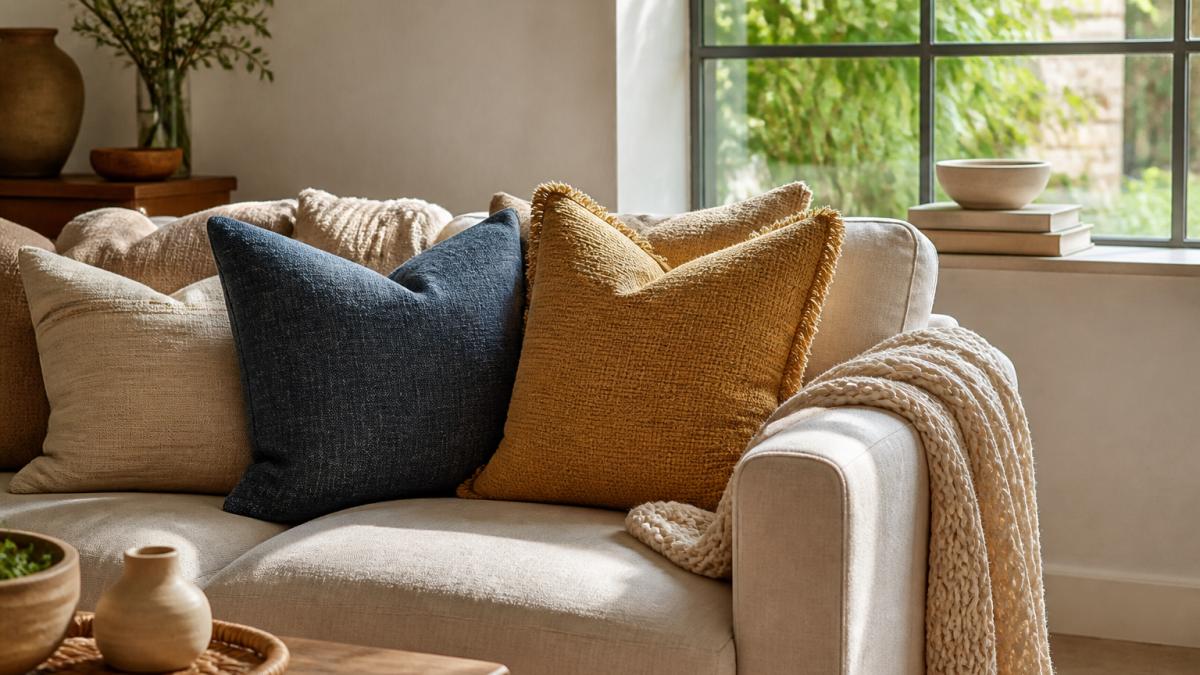
Mix sizes and edges rather than matching a set. A 45 × 45 cm square beside a 35 × 60 cm lumbar creates a stepped line that looks styled, not staged.
- Geometric Cushion, Ochre ($60, 45 × 45 cm): a warm accent that lifts neutral sofas.
- Stripe Frill Cushion ($64, 45 × 45 cm): defined lines with a soft frill edge.
- Moss Frill Lumbar Cushion ($57, 35 × 50 cm): fluffy-edged comfort in Blue/Natural.
For a step-by-step arrangement method, read how to style cushions on a sofa.
How to Style a Curated Home Without Hiring a Designer
You can style a curated home yourself with a fixed process and a small budget. The trick is to work in layers and stop before the room looks full.
- Pick your palette first. Choose two base tones and one accent, then hold to it across every room.
- Start with the largest surface. A throw or rug sets the temperature of the room.
- Add texture in threes. Knit, weave and a smooth finish together read as intentional.
- Style at eye level. Cushions, candles and decorative vessels draw the eye up.
- Leave one surface empty. Negative space is what makes a curated room feel calm.
- Rotate seasonally. Swap two or three pieces rather than rebuying everything.
Watch out: buying every piece in one shopping trip is the most common mistake. A room styled over a few months looks collected; a room styled in an afternoon looks like a showroom.
Building Your Curated Look with AVE-BA HOUSE
AVE-BA HOUSE exists for the shopper who wants a home sanctuary, not a catalogue page.
What that means in practice:
- A tight edit. Every piece is chosen to layer with the others, which removes the guesswork.
- Texture as the focus. Cotton knits, frill edges, fringe and pom-pom finishes give you the depth a curated look needs.
- Comfort and style together. Pieces are designed to be used daily, not saved for guests.
If you have been scrolling Instagram and buying similar-looking throws from five different stores, shopping one curated range solves the matching problem. You get pieces that already agree with each other.
Curated pieces are often offered in a limited range of colours, so a favourite tone may not always be available. Buying the hero piece first is a sensible approach.
Frequently Asked Questions
What are the best alternatives for home decor?
The best alternative depends on what you value most. If you want curated decor with distinctive textures, AVE-BA HOUSE offers throws from $87 to $100 and cushions from $57 to $64, with pieces designed to mix and match. Look for retailers that publish material details, show true-to-life product photos and offer clear returns, so you can judge quality before you commit.
How do I make my home look curated rather than cluttered?
Start with a restrained colour palette of two or three tones, then layer texture instead of volume. A chunky knit throw and two or three cushions in different sizes will do more than ten small ornaments. Keep surfaces mostly clear, group similar items together and repeat one material, such as cotton knit, across the room so the space feels intentional rather than busy.
Where can I buy cushions and throws with a more distinctive style?
Specialist home decor stores tend to carry more distinctive ranges than large general retailers. Look for details like frill edges, fringe, herringbone weaves and tassels, which add character without shouting. AVE-BA HOUSE, for example, stocks lumbar cushions from $57 and square cushions from $60 in ochre, blue and natural colourways that work together across a room.
How can I mix decor from different brands cohesively?
Anchor the room with a single colour palette, then let texture do the work. Choose one dominant neutral, add one accent colour and repeat it in at least two places. Keep materials in the same family, such as cotton knits and natural linens, and vary scale rather than style. That approach lets pieces from different home decor stores sit together without looking mismatched.
Is affordable home decor worth buying, or does it fall apart quickly?
Price alone does not predict quality. Check the material composition, the size in centimetres and the care instructions before buying. Cotton knits and tightly woven textiles generally wear better than loose synthetic blends. Reading reviews about pilling and seam quality helps too, and a clear returns policy protects you if a piece does not feel as premium as it looked online.
The challenge most shoppers face is not finding decor, it is finding pieces that belong together. AVE-BA HOUSE solves that with a curated collection of textured cushions and cotton-knit throws, each designed to layer with the rest of the range. Browse the collection and start with one piece that anchors the room. Get started with AVE-BA HOUSE and build a living space that feels collected, warm and yours.
