
Table of Contents
- How to Arrange Cushions on a Sofa: The Foundation
- How Many Cushions on a Sofa: Finding Your Balance
- Choosing Cushion Sizes and Proportions
- Patterned Cushions vs Plain Cushions for a Sofa
- Building a Coordinated Colour Palette
- Combining Textures and Fabrics for Visual Interest
- Cushion Arrangement Ideas for a Sectional Sofa
- Common Mistakes to Avoid
- Frequently Asked Questions
Last Updated: October 19, 2026
How to Arrange Cushions on a Sofa: The Foundation
When you're learning how to style cushions on a sofa, the arrangement method matters more than you'd think. Most people grab a handful and toss them on without considering order or proportion. That's where the magic disappears.
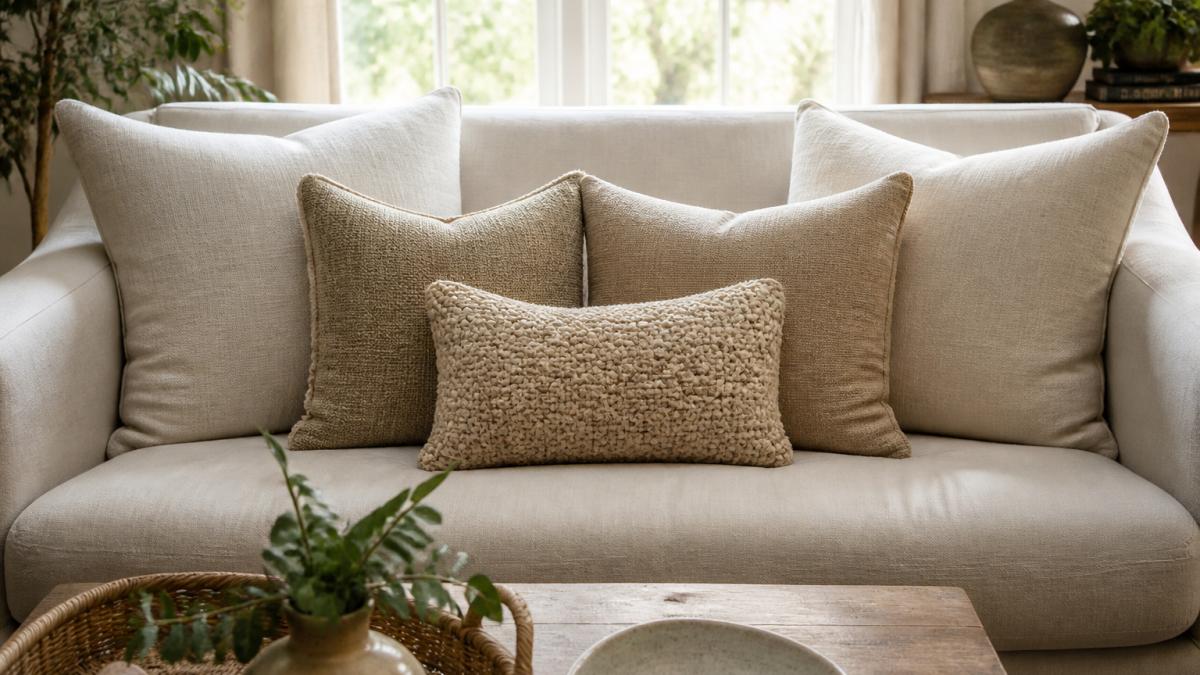
The real secret to how to style cushions on a sofa comes down to one principle: work largest to smallest, back to front. This creates visual depth and balance that makes your seating feel intentional rather than random.
Largest at the back, smallest at the front
Start with your largest cushion at the back of the sofa. This becomes your anchor. It sits against the cushion, creating a backdrop.
Place medium-sized cushions in front of it. Then add your smallest scatter cushions at the very front edge. This layering creates what designers call "visual hierarchy", your eye moves from bold statements down to delicate accents.
Why does this work? Larger shapes naturally draw attention. By placing them behind, you establish depth without overwhelming the space. Smaller cushions in front feel like finishing touches rather than clutter.
Working with odd numbers
Odd-numbered groupings feel more organic to the human eye. A sofa with three cushions looks intentional.
Try this arrangement: one large square cushion at the back, two medium cushions flanking it, and two small lumbar or rectangular cushions at the front edges.
If your sofa is smaller, three cushions work beautifully. Place one large one centre-back, then two smaller ones in front on either side.
The odd-number rule isn't rigid, but it's a reliable starting point. Once you see how it looks, you can adjust based on your specific space.
How Many Cushions on a Sofa: Finding Your Balance
The number of cushions you need depends on your sofa's size and shape. Too few and your seating feels bare. Too many and it becomes a chore to move them when you want to sit down.
Standard sofas and loveseats
A standard three-seater sofa typically works best with five to seven cushions. This gives you enough visual interest without making the sofa unusable.
For a loveseat or two-seater, three to four cushions is ideal. One large cushion at the back with two smaller ones in front creates a balanced look without overwhelming the compact space.
The rule of thumb: your cushions should take up roughly one-third to one-half of your seating surface. Any more and you're creating an obstacle course.
Sectional sofas and larger seating
Sectional sofas offer more creative freedom. A large L-shaped sectional can handle ten to fifteen cushions across both sections, but distribute them thoughtfully.
On the longer section, use the back-to-front layering method as you would on a standard sofa. On the shorter section or corner piece, scale down proportionally. A corner seat might hold just two or three cushions instead of five.
The key is maintaining visual balance across the entire piece. If one section is heavily cushioned and the other is bare, the seating looks unfinished.
Choosing Cushion Sizes and Proportions
Size variety creates visual interest. If every cushion is the same dimensions, your sofa looks flat and uniform.
Square, lumbar, and rectangular options
Square cushions (typically 45 × 45 cm) work as your anchor pieces. The Geometric Cushion in Ochre from AVE-BA HOUSE is a perfect example, its substantial size makes it ideal for back-row placement.

Lumbar cushions (typically 35 × 50 cm or 35 × 60 cm) bridge the gap between large and small. The Moss Frill Lumbar Cushion adds both size and texture without dominating the space.

Smaller rectangular options create finishing layers. These sit at the front edge and add detail without bulk.
Mix these three sizes across your sofa. A common winning formula: one large square, two medium lumbar pieces, and two to three smaller accents. This creates visual progression that feels intentional.
Patterned Cushions vs Plain Cushions for a Sofa
The balance between pattern and solid colour determines whether your sofa looks curated or chaotic.
Mixing patterns without overwhelming the space
Pattern mixing is where many people stumble. The instinct is to play it safe with all solids or all patterns. The truth is more nuanced.
A good rule: limit yourself to two or three patterns maximum on one sofa. Too many competing prints create visual noise.
Start with one bold pattern, perhaps a geometric print on a medium-sized cushion. The Stripe Frill Cushion works well here, with its defined linear pattern offering visual interest without overwhelming.

Place your patterned pieces in the middle layer of your arrangement, not at the back or front. This gives them prominence without dominating.
Balancing solids with geometric and textured prints
Solids are your foundation. They anchor the arrangement and let patterns shine. Aim for 60-70% solid cushions and 30-40% patterned or textured pieces.
Textured fabrics add depth even when they're solid colours. A plush velvet in a neutral tone reads differently than a crisp linen in the same shade. Texture creates visual interest without relying on pattern.
Consider layering a solid square cushion with a textured lumbar cushion in front. Then add a small patterned piece to one side. This creates dimension without chaos.
Building a Coordinated Colour Palette
Colour ties your entire arrangement together. Without coordination, even well-proportioned cushions look disconnected.
Complementary and accent colours
Start with your sofa's base colour. This is your anchor. Everything else builds from here.
Choose one complementary colour, a shade that sits opposite your sofa colour on the colour wheel. If your sofa is grey, a warm ochre or terracotta works beautifully.
Use your complementary colour sparingly, perhaps on one or two cushions. The Geometric Cushion in Ochre provides that pop without overwhelming a neutral sofa.
Then add accent colours in smaller doses. A blush, sage, or soft blue in tiny amounts creates visual interest.
Matching your sofa colour and room context
Your cushions should feel like they belong in your room, not like you grabbed them randomly.
If your room has warm lighting and warm-toned walls, lean into warm cushion tones, ochres, warm greys, soft terracottas.
Your sofa colour is the starting point. If it's a warm grey, pull warm-toned cushions. If it's a cool grey, cool tones feel more cohesive.
The Herringbone Fringe Lumbar Cushion in stone or blue works across multiple room contexts because these neutral tones adapt to their surroundings.
Combining Textures and Fabrics for Visual Interest
Texture is where many people miss an opportunity. Plain fabrics in coordinated colours can feel flat. Mixing textures transforms the same colour palette into something rich and inviting.
Layering plush, woven, linen, and velvet
Start with a base of natural linen or woven fabric. These feel fresh and understated. Layer plush velvet or faux fur on top for contrast. The softness of velvet against the structure of linen creates tactile interest.
Add a woven or textured piece to the mix. This creates three distinct textures working together. Your eye moves across the surface, noticing depth and dimension.
Avoid using the same fabric twice on one sofa. Even if the colours work, repeated textures make the arrangement feel less intentional.
Choosing cushion inserts for shape and comfort
The insert matters as much as the cover. A cushion with a poor insert loses its shape and looks saggy within weeks.
Polyester inserts are durable and hold their shape well. They're also affordable, making them ideal for cushions you'll rotate seasonally. All AVE-BA HOUSE cushions feature polyester inserts designed to maintain their form through regular use.
The insert size should match your cover exactly. Loose inserts shift and bunch. Properly fitted inserts keep your arrangement looking polished.
Cushion Arrangement Ideas for a Sectional Sofa
Sectional sofas offer different challenges than standard sofas. The corner creates a natural focal point that changes how you arrange pieces.
Adapting the layering method to corner and wraparound seating
The corner is your anchor point. Treat it like the back of a standard sofa, place your largest cushion here.
On the longer section extending from the corner, use the back-to-front layering method. On the shorter section, scale down proportionally. A chaise section might hold just two cushions instead of five.
Maintain visual flow across the entire sectional. If you're using a pattern on one section, echo it (but don't repeat it exactly) on another section. This creates coherence across the larger footprint.
Visual balance across extended seating
Extended seating requires intentional distribution. Don't cluster all your cushions on one section. Spread them across the entire piece so the eye travels around the whole arrangement.
A common mistake is over-cushioning the corner and leaving the arms bare. Instead, balance them. Place substantial pieces in the middle of each section, with smaller pieces at the edges and corners.
Think of your sectional as multiple smaller sofas arranged together. Style each section as you would style a standalone sofa, then step back and check the overall balance.
Common Mistakes to Avoid
Most styling missteps come from either too much caution or too much ambition.
Matching cushions perfectly is one of the biggest mistakes.
Another common error is placing all your cushions in a straight line. This creates a formal, stiff look rather than a curated arrangement.
Over-cushioning is tempting when you love beautiful pieces.
Ignoring your room's existing colours is another misstep.
Finally, never underestimate the power of negative space. An intentionally sparse arrangement often looks more sophisticated than a heavily cushioned one.
Creating a well-styled sofa doesn't require professional design experience. Our scatter cushions come in coordinated colours and complementary sizes, from the substantial Geometric Cushion in Ochre to the refined Moss Frill Lumbar Cushion, all with carefully chosen inserts that hold their shape through daily use.
Frequently Asked Questions
How many cushions should you put on a sofa?
The number depends on your sofa size and personal preference. A standard three-seater sofa typically works well with 4-6 cushions: two larger ones at the back, two medium ones in the middle, and 1-2 smaller accent pieces in front. Loveseats suit 2-3 cushions, while sectional sofas can accommodate 6-10 or more. Odd numbers (3, 5, 7) tend to create a more visually balanced, asymmetrical look than even groupings. Start with fewer cushions and add more until the arrangement feels inviting without overcrowding your seating.
How do you mix patterned and plain cushions on a sofa?
Use the 60/30/10 rule: 60% solid colours (your base), 30% one pattern type (geometric or floral), and 10% a contrasting accent pattern or texture. Pair geometric prints with florals sparingly, let one pattern dominate. Separate patterned cushions with plain solids to prevent visual chaos. If your sofa is patterned, choose cushions in solid complementary colours. Ensure all patterns share at least one colour from your coordinated palette to maintain cohesion. This approach keeps the space sophisticated rather than trendy.
What cushion colours go together on a sofa?
Start with your sofa's base colour and build around it. Complementary colours (opposite on the colour wheel) create visual interest, pair warm ochres with cool blues, or soft greys with blush tones. Stick to 2-3 main colours plus neutrals like white, cream, or taupe. Accent colours should appear in no more than one or two cushions to avoid overwhelming the space. Test your palette by placing cushions together before committing; colours look different under your home's lighting than online. Neutral backgrounds allow patterned and textured cushions to shine without competing.
How do I choose cushion inserts that maintain their shape?
Look for polyester inserts, polyester holds its form longer and resists flattening. Rotate and fluff cushions weekly to extend their lifespan. AVE-BA HOUSE cushions feature polyester filling designed for durability and consistent comfort, ensuring your styled arrangement stays inviting season after season.